

Quick answer: A vulnerability scan uses tools to identify potential security weaknesses, often repeatedly and at scale. A website security audit reviews security controls, configurations, processes and evidence against an agreed scope. A penetration test is an authorized, time-bounded effort to validate whether weaknesses can be exploited and what impact they may have. These methods overlap, but they answer different questions: What looks vulnerable? Are the controls appropriate and working? Can a realistic attack path succeed? A mature website security program may use all three rather than choosing one permanently.
Do not assume that the name on a proposal guarantees a particular depth of testing. Some vendors call a software scan an audit; others include manual testing in a comprehensive audit. A penetration test may include vulnerability scanning, but it is not automatically a complete review of backups, policies or operational processes. The NIST Technical Guide to Information Security Testing and Assessment explains that different examination and testing techniques have distinct benefits and limitations. The OWASP Web Security Testing Guide provides a framework for planning and performing web application security tests.
At a glance: what each assessment is designed to do
| Question | Vulnerability scan | Security audit | Penetration test |
|---|---|---|---|
| Primary goal | Flag potential weaknesses using repeatable checks. | Evaluate selected security controls and their evidence. | Validate exploitable weaknesses within authorized scope. |
| Typical approach | Automated discovery and detection rules. | Review, interviews, configuration checks and selected testing. | Manual analysis supported by tools and controlled validation. |
| Access needed | May be external-only or authenticated. | Often requires configuration and process evidence. | Depends on black-box, gray-box or white-box scope. |
| Common deliverable | Findings list with evidence and detection confidence. | Control gaps, risk priorities and corrective actions. | Validated findings, impact and reproducible evidence. |
| Typical repetition | Can run frequently after changes. | Periodic or triggered by material changes. | At defined milestones or after major risk changes. |
| Main limitation | False positives and blind spots in logic and context. | Quality varies with scope and evidence depth. | Time-boxed; not proof that all vulnerabilities are absent. |
These are practical distinctions, not rigid legal definitions. Ask a provider to list exactly what it will examine, what it will attempt to validate and what it will leave untested. For a quote-focused discussion, see our separate website security audit cost guide; this article focuses on methodology and when each method is useful.
What is a vulnerability scan?
A vulnerability scan is a systematic check that uses a scanner or a set of tools to identify possible weaknesses. For a WordPress site, checks may include installed software versions with known advisories, exposed configuration files, missing security headers, outdated components or recognizable insecure settings. Other tools can inspect servers, network services, cloud configurations or application endpoints. The exact findings depend on the scanner’s visibility, credentials and detection logic.
Scanning is valuable because it is repeatable. A business can run approved checks after software updates, before deployment or on a scheduled basis. Results can reveal newly disclosed weaknesses or configuration drift. Authenticated scanning can often see more than an external-only scan, but granting credentials introduces access-management responsibilities. Use dedicated accounts with appropriate permissions and remove access when the engagement ends.
Scanners do not understand every business rule. They may report a version that appears vulnerable even though a host has applied a backported fix. They may also miss an authorization error in a custom workflow because the tool does not know which customer should be allowed to see which record. A successful scan therefore means only that the selected checks did not find additional issues within their visibility. It does not certify that a site is secure.
Be careful with active scans against production websites. High request volume or certain test cases can trigger security controls, affect performance or create unwanted records. Always obtain authorization and coordinate testing windows, rate limits and exclusions. A passive external check and an authenticated active scan have different operational risk.
What is a website security audit?
A security audit asks whether selected controls are appropriate, implemented and supported by evidence. For a WordPress business site, it can include administrator account inventory, update processes, backup and restore readiness, access controls, hosting and CDN responsibilities, plugin inventory, malware indicators, configuration and logging. It can also incorporate scan results or targeted manual tests. The auditor should state the criteria and scope rather than presenting a generic checklist as a universal standard.
A useful audit looks beyond individual vulnerabilities. For example, a plugin may be fully updated but its administrator access may be shared among multiple staff members. That is an operational control weakness even if a vulnerability scanner reports no known software flaw. A backup system may be enabled, yet no one has ever tested a restoration. The audit can flag the gap between having a feature and being able to rely on it.
The official WordPress hardening handbook emphasizes risk reduction, limited access, trusted software and recovery preparation. The OWASP Application Security Verification Standard can help define more technical application controls for an assessment. Neither source means every small website needs every advanced test; scope should follow business risk.
Some audits are entirely documentary or configuration-focused, while others include hands-on validation. Ask whether the auditor will verify that controls work or simply record that a setting exists. A report should identify confirmed issues, unverified concerns, limitations, owners and prioritized next steps.
Tell us about your website and the security concerns you want to address.
Talk to Defendoria ↗What is penetration testing?
A penetration test is an explicitly authorized exercise that seeks to validate security weaknesses and possible attack paths in a defined system. A tester may analyze authentication, authorization, sessions, input handling, business logic, APIs and configuration, using tools and manual reasoning. The objective is to demonstrate meaningful risk without causing unnecessary damage. Testing must follow written rules of engagement, including permitted targets, accounts, techniques, times and escalation procedures.
Unlike a generic scan, a tester can reason about how multiple weaknesses interact. For example, a custom customer portal might enforce login correctly but fail to restrict access to another customer’s invoice when a record identifier changes. Detecting that type of problem may require authenticated test accounts and knowledge of expected permissions. The OWASP authorization testing guidance documents why access-control checks deserve dedicated attention.
A penetration test does not necessarily include malware cleanup, backup restoration, employee training or a complete review of governance. It is time-bounded, and even an expert tester cannot prove the absence of every vulnerability. Ask whether the engagement includes retesting after fixes and whether the final report distinguishes confirmed exploitability from suspected weaknesses.
Do not conduct penetration tests against a third-party website or production integration without authorization. When possible, use a representative staging environment with safe test data. If production testing is required, coordinate with the owner, host and payment or API providers so that the scope is lawful and operationally controlled.
Where the methods overlap—and where they do not
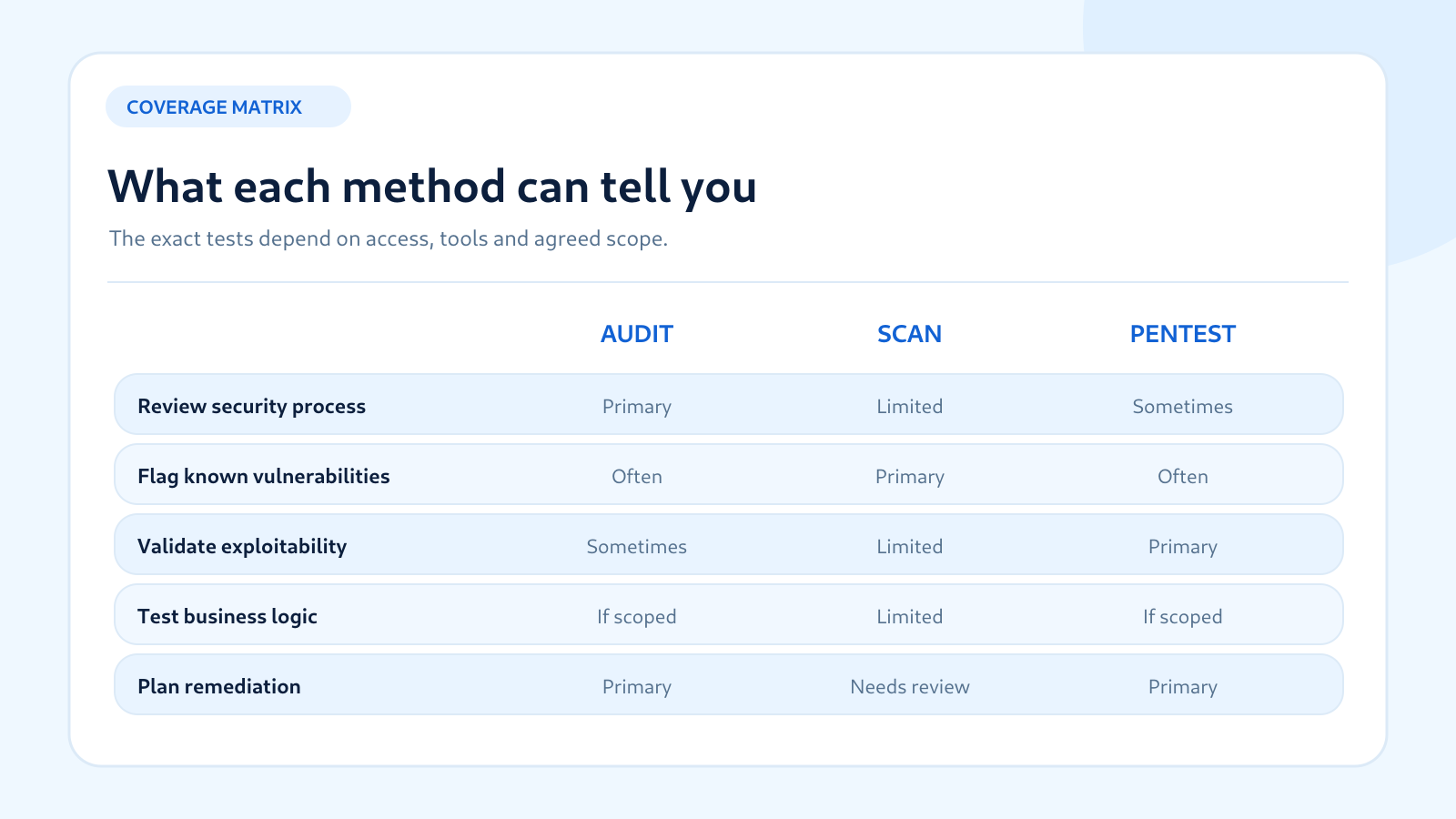
A security audit may use a vulnerability scanner as one source of evidence. A penetration tester will often use scanners to identify promising areas for further analysis. A vulnerability scan may be performed during a broader assessment, but its output does not automatically become an audit or a penetration test. What matters is the purpose, evidence, validation and report.
Consider a WordPress plugin that has a published vulnerability advisory. A scanner may identify the installed version as potentially affected. An auditor may verify whether the component is enabled, exposed, patched, monitored and subject to an update policy. A penetration tester may, if explicitly authorized and safe, investigate whether the weakness is reachable and has a meaningful impact in that environment. These are related but different questions.
The same distinction applies to login security. A scan may identify exposed login endpoints or missing rate limits. An audit may examine password policy, multi-factor authentication enrollment and access reviews. A penetration test may evaluate whether an actual authorization or session weakness can be demonstrated with approved test accounts. No single finding list replaces the full picture.
Why scanner findings need human validation
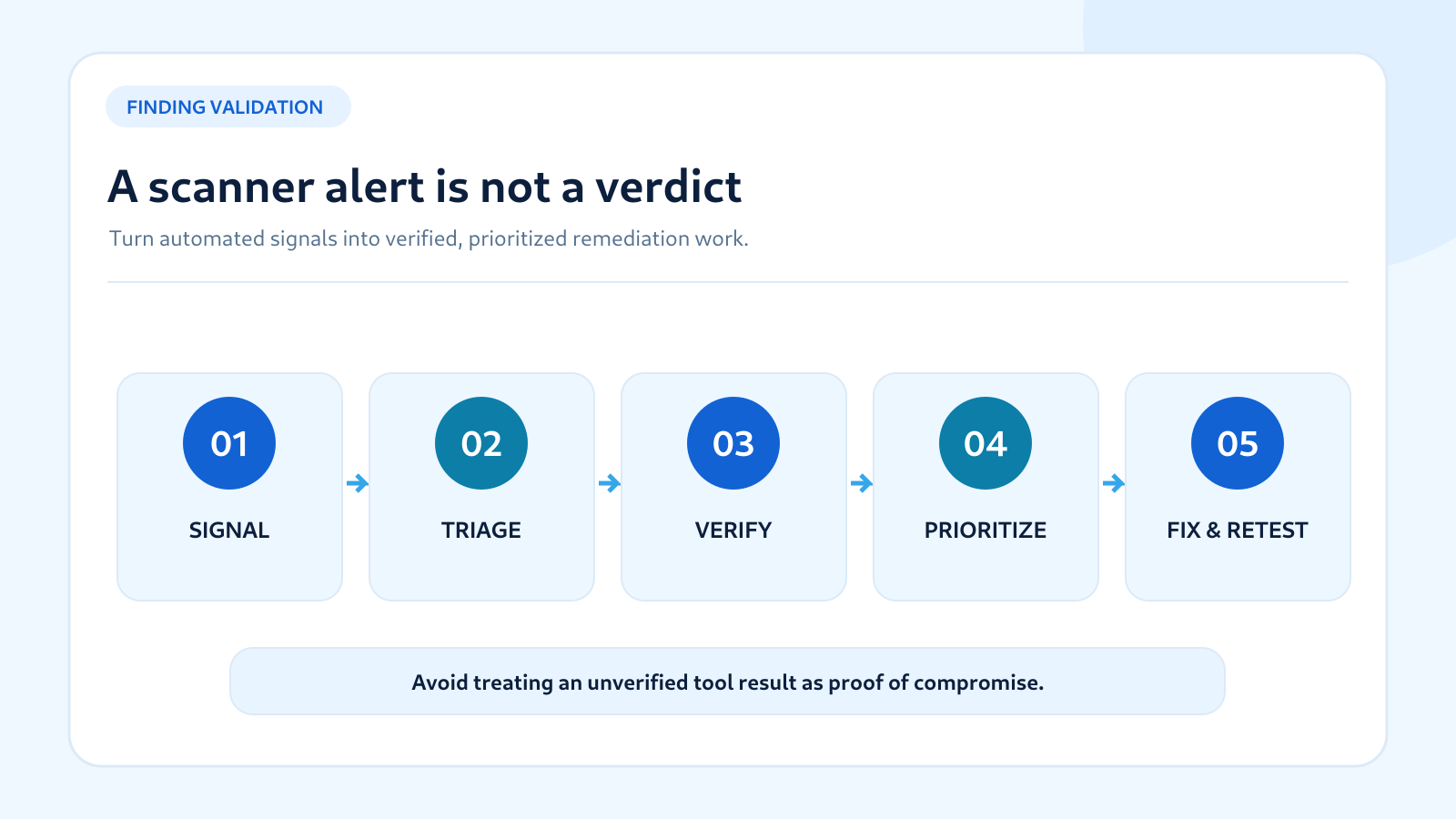
A scanner finding is evidence that a rule matched observed data; it is not always proof that a website is compromised or exploitable. For example, a detected software version may be incorrect because of caching, a hidden patch or a custom build. Conversely, a scanner might fail to see an issue in an authenticated feature that it never accessed. This is why useful reporting includes the detection method, affected asset, confidence, conditions and recommended verification.
Start by confirming that the affected component actually exists and is in scope. Check the authoritative advisory or vendor documentation, then consider whether the vulnerable feature is enabled and reachable. Do not attempt intrusive validation without permission. Evaluate potential business impact and available compensating controls before assigning remediation priority. After the fix, retest the specific finding and document the result.
It is also important to distinguish a vulnerability from an incident. A vulnerable plugin is a weakness that may be exploited; it does not prove an attacker has accessed the site. Unexpected administrators, injected content or malicious redirects may indicate a compromise that requires incident response rather than routine vulnerability management. See how to check WordPress plugin vulnerabilities and the warning signs of a hacked WordPress site.
Which method should a small business choose first?
For a relatively simple brochure website, a focused security audit can be a useful starting point because it examines practical gaps such as software updates, privileged accounts, backups, forms and hosting responsibilities. Routine scanning can then help track known vulnerabilities between reviews. If the site has no custom authentication or complex application logic, a full penetration test may not be the first investment unless a customer contract or specific risk requires it.
For a WooCommerce store, the picture changes. The website may process orders, maintain customer accounts and rely on payment or shipping integrations. A baseline audit should examine those workflows and access controls. Regular vulnerability scanning helps detect component issues, while targeted penetration testing can be justified for custom checkout logic, customer account boundaries or other high-impact features. The scope should reflect the actual architecture, not assume every WooCommerce site is identical.
For a custom SaaS or membership platform, manual testing of authorization, sessions and business logic becomes more important. Scanning remains useful, but a periodic penetration test or a deeper application assessment may be needed to examine the behavior of different user roles and APIs. The OWASP ASVS can provide a common language for specifying security requirements and expected verification coverage.
For agencies managing multiple client sites, a repeatable scanning process can help identify outdated components across the portfolio. An audit can evaluate shared operating practices, credentials, backup ownership and escalation. Targeted penetration tests can focus on the most complex or sensitive client applications. The agency should document client authorization and avoid assuming that permission to maintain a site automatically includes permission for aggressive security testing.
Use the question you need answered to select the assessment
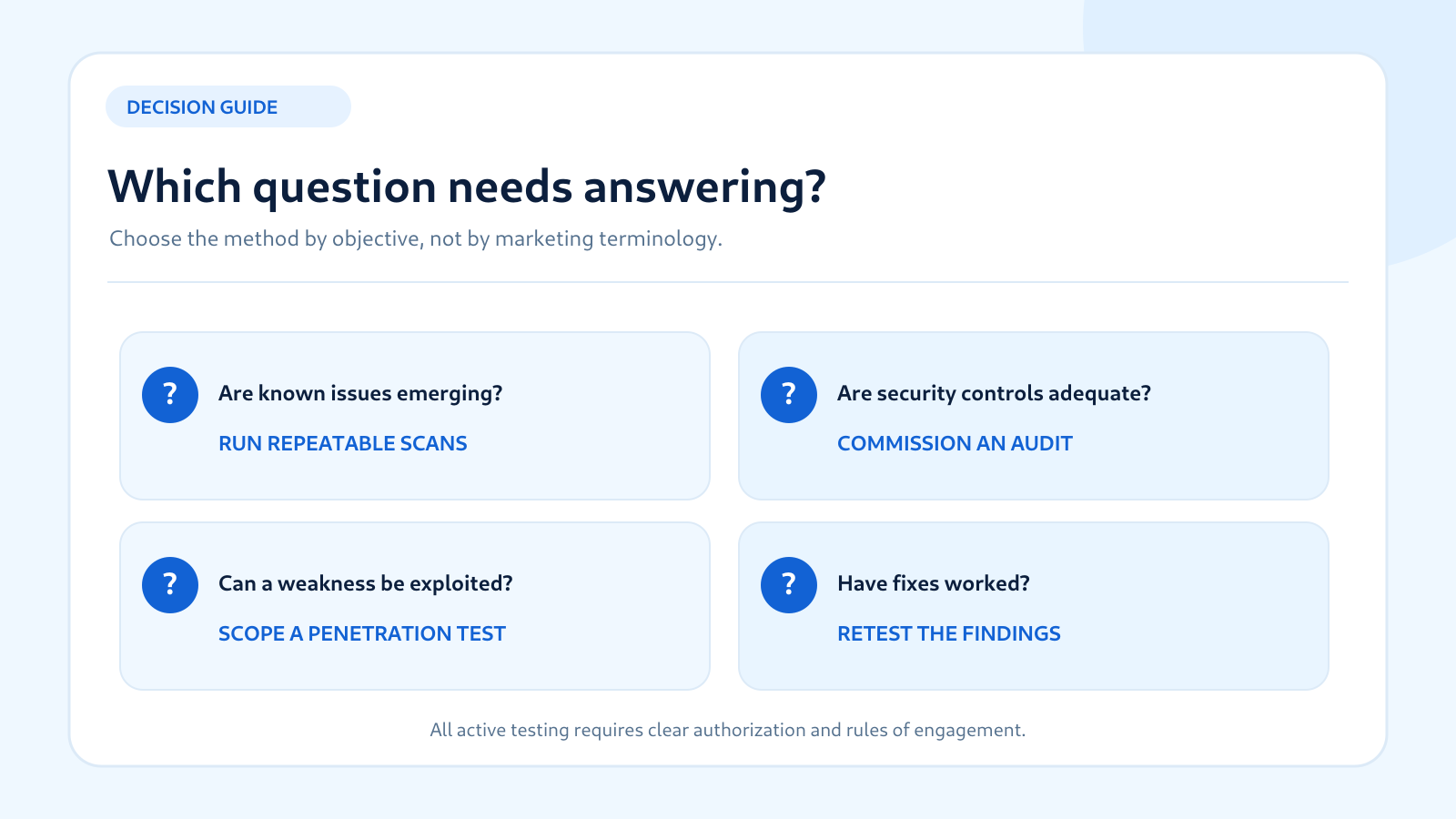
If your question is “Which known vulnerabilities appeared after the latest update?”, choose a repeatable scan with appropriate credentials and careful triage. If the question is “Are we maintaining this website safely?”, commission a scoped audit that reviews people, process and technical controls. If the question is “Can someone cross this account boundary or abuse this workflow?”, seek an authorized penetration test or focused manual application assessment.
If the question is “Was our site hacked?”, neither a routine scan nor a scheduled audit is necessarily sufficient. A suspected active compromise may require incident investigation, evidence preservation, containment and recovery. For that situation, our website malware removal and recovery service page outlines the type of support to discuss. Avoid destroying evidence by deleting suspicious files before a qualified investigation.
Finally, if the question is “Did the fix work?”, request a focused retest of the relevant finding. You do not always need to repeat the entire assessment, although significant architecture changes may justify broader testing. The right choice depends on the changes made and what remains unverified.
How to define safe rules of engagement
Before active testing, the owner and assessor should agree in writing on the target domains, IP addresses, applications, APIs, environments, account roles and third-party systems. Identify excluded paths, testing hours, acceptable request rates and techniques that are prohibited. Include an emergency contact and a process for stopping testing if unexpected instability occurs.
Prepare representative test accounts rather than sharing a real employee’s password. Use non-production data where possible, and explain whether test transactions, email notifications or account changes are permitted. For WordPress, confirm that the hosting provider and any CDN or payment service allow the planned tests. Keep a reliable backup and recovery contact available, especially if production systems are in scope.
The NIST SP 800-115 guidance organizes technical assessment around planning, execution and analysis. Its publication date is September 2008, so it should be used as foundational methodology alongside current platform and testing guidance, not as a source of present-day vulnerability lists. The OWASP WSTG provides more directly web-application-focused testing techniques.
What good deliverables look like for each method
Vulnerability scan report
Expect an asset list, scan date, authenticated or unauthenticated scope, scanner configuration, identified findings, detection confidence and enough evidence to triage results. The report should identify false-positive candidates and provide links to authoritative advisories when applicable. A raw severity score without a component name, affected version or explanation is not especially useful.
Security audit report
Expect an agreed control checklist, a summary of evidence reviewed, gaps and limitations, prioritized remediation, accountable owners and a clear distinction between verified findings and recommendations. It should address operational risks that scanners often miss, such as absent restore tests or unmonitored administrator access. A business-friendly executive summary helps decision-makers approve corrective work.
Penetration test report
Expect written scope and rules of engagement, methodology, a summary of tested attack surfaces, validated findings with safe reproduction evidence, business impact, remediation guidance and any agreed retest results. The report should avoid unnecessarily exposing credentials or customer data. It should also state what was not tested so readers do not mistake the result for an unlimited guarantee.
All three reports should be stored securely because they can reveal system weaknesses. Access should be restricted to people who need to act on the findings, and sharing with third parties should follow the organization’s policies and contracts.
Common mistakes when comparing assessments
Buying a “full security audit” without a written scope. This can result in a scan report when the buyer expected manual review of accounts and checkout logic. Ask for a sample redacted report and a list of included tests.
Treating a clean scan as proof of security. Automated tools can miss business-logic errors, unauthorized access and malicious behavior that requires context. A clean result only describes the selected checks.
Assuming a penetration test covers every operational control. Testing an application does not automatically verify backup recovery, employee offboarding or third-party data-handling practices. Those may belong in an audit.
Testing without authorization. Security testing can disrupt services or affect other organizations. Written permission and boundaries are essential even when the intention is defensive.
Skipping remediation and retesting. A report has limited value if findings remain unassigned. Prioritize fixes, document changes and verify that the important weaknesses were actually addressed.
Confusing a security assessment with compliance certification. A general scan, audit or penetration test does not automatically satisfy every legal or contractual requirement. The applicable framework and required evidence must be established separately.
A practical sequence for a WordPress business website
- Inventory the website. Record WordPress core, plugins, themes, hosting, DNS, CDN, administrators, forms, integrations and backup arrangements.
- Agree on the threat model. Identify critical workflows, sensitive data, business interruption risks and who owns each component.
- Perform baseline checks. Use authorized scanning and configuration review to identify known issues and obvious gaps.
- Conduct a scoped audit. Review access, updates, backups, monitoring, security configuration and evidence of operational controls.
- Target manual testing. Commission deeper authorized testing where custom roles, APIs, checkout logic or other high-risk features justify it.
- Remediate and verify. Assign owners, fix the most important issues safely and retest the affected controls.
- Repeat proportionately. Scan after meaningful changes and reassess the site when business functions, software or risk materially change.
This is a planning sequence, not a mandatory certification program. Some sites will need a more specialized process, while others can start with a narrower baseline. The objective is to avoid spending money on the wrong kind of evidence.
Frequently asked questions
Is a vulnerability scan the same as a penetration test?
No. A scan flags potential weaknesses through defined detection rules. A penetration test uses authorized testing to validate whether vulnerabilities or combinations of weaknesses can be exploited within scope. Penetration testers often use scanners, but the two activities are not equivalent.
Does a website security audit include a vulnerability scan?
It may, but the word “audit” does not guarantee that. Some audits focus on controls and configuration, while others combine automated scanning and manual review. Request a detailed scope and deliverables list.
Can automated tools find every WordPress vulnerability?
No. Tools have visibility limits and may miss custom logic, certain authorization failures or problems outside their configured checks. They can also report false positives. Manual validation and contextual review remain important.
How often should a website be scanned?
Frequency depends on exposure, change rate and business risk. Repeatable checks are useful after updates or deployments and at a regular cadence appropriate to the site. A scan schedule does not replace timely patching or alert review.
When is a penetration test worth considering?
It is particularly useful for custom applications, complex account roles, APIs, sensitive data flows, important ecommerce features or when a contract requires independent testing. Define the objective and authorization before selecting a provider.
Can I run a penetration test on my live website?
Only with appropriate authorization and an agreed plan to control risk. Production testing may affect performance, data or third-party services. Use staging and safe test data where feasible, and coordinate any necessary production testing with responsible parties.
Will an audit or penetration test guarantee that the site is secure?
No. Both are limited by scope, time and available evidence. New vulnerabilities and configuration changes can arise after testing. Good security also requires ongoing maintenance, monitoring, access management and recovery planning.
Which assessment should a small WordPress site buy first?
For a simple business site, a scoped audit of updates, accounts, configuration, backups and monitoring can be a practical starting point, supported by repeatable scanning. Custom or high-impact features may justify deeper manual testing. The choice should follow risk, not marketing labels.
What if a scan reports a critical vulnerability?
Confirm the affected component and authoritative advisory, assess exposure and business impact, and plan safe remediation promptly. Do not assume the site has been compromised solely because a scanner matched a vulnerability signature. Preserve evidence if there are separate signs of intrusion.
Final decision: combine methods where they add different evidence
Vulnerability scanning is good at repeatable detection, audits are good at reviewing whether controls and responsibilities are adequate, and penetration tests are useful for authorized validation of attack paths. None is a substitute for fixing issues or maintaining the website. Define the question, scope, evidence and remediation plan before selecting the service.
If you need a structured starting point, review Defendoria’s website security audit service, our WordPress security service, or contact Defendoria to discuss which assessment approach fits your website. A useful engagement should explain its limits and produce actions that the website team can implement and verify.
Authoritative references
- NIST SP 800-115 — Technical Guide to Information Security Testing and Assessment (September 2008): foundational distinctions among examination, testing and validation techniques.
- OWASP Web Security Testing Guide: web application testing methodology, scope and techniques.
- OWASP WSTG v4.2 — Authorization Testing: examples of access-control testing categories.
- OWASP Application Security Verification Standard: verifiable application security requirements.
- WordPress Developer Resources — Hardening WordPress: practical platform hardening and risk reduction.
- OWASP — How to Use the Top 10 as a Standard: why broad vulnerability categories are not a complete verification checklist.
Editorial review: October 29, 2026. This article explains general assessment methods; it is not an authorization to test third-party systems or a claim that any particular website has been assessed. Methods, tools and requirements should be chosen for the actual environment.
This is general educational guidance, not a security assessment of a specific website. Obtain authorization before any technical testing.